

Want the Full Framework?
Stop Guessing. Start Operating With Data →Some stories begin quietly. This one doesn’t.
This one starts with $20,000 that went straight into a funnel we assumed would work. A funnel that looked clean, logical and predictable. The kind of funnel marketers love to present because it makes everything look under control.
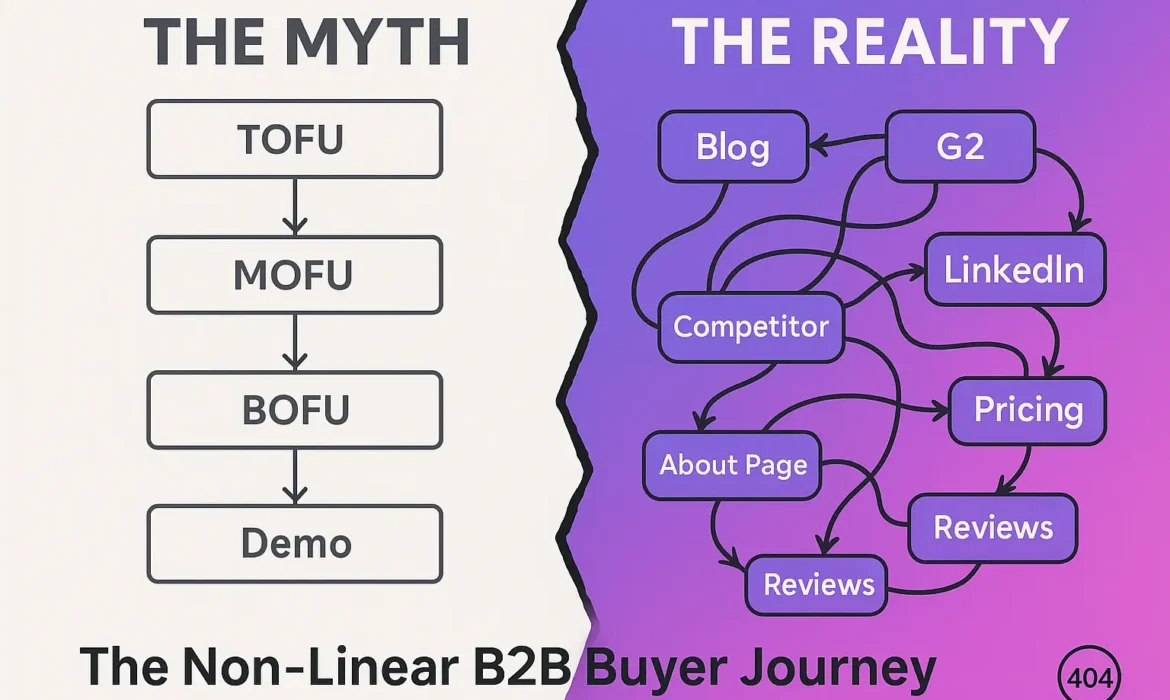
TOFU > MOFU > BOFU > Demo.
A perfect sequence.
A perfect lie.
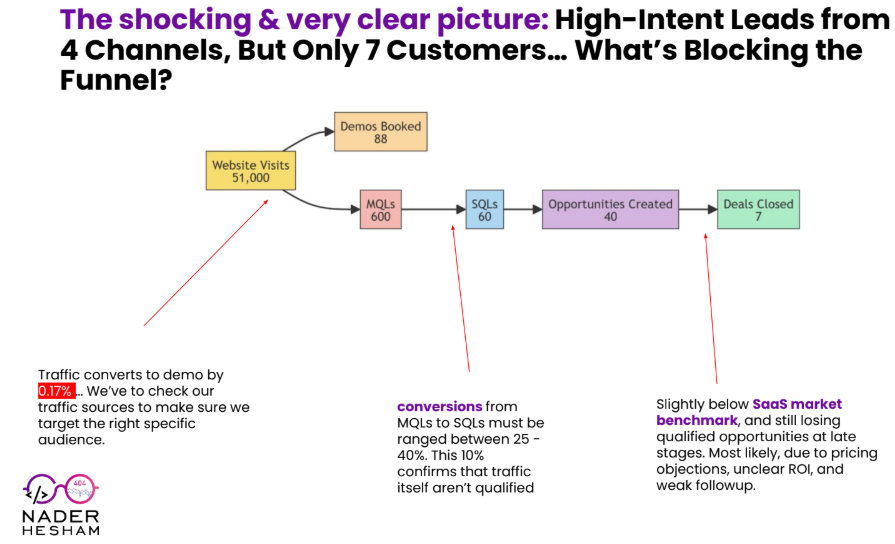
The money didn’t disappear because the campaign failed. It didn’t disappear because the content was bad. It disappeared because the entire funnel was built on a fantasy. We convinced ourselves that buyers move in stages. That they read what we expect them to read. That they behave the way our slides say they should.
But buyers don’t care about our diagrams.
They don’t walk in a straight line.
They don’t follow the neat path we sketch out in strategy decks.
The truth is simple.
The funnel didn’t fail.
The idea of the funnel was the failure.
The problem wasn’t the spend.
The problem was believing that the model was real.
The Myth of the Linear Funnel
The traditional marketing funnel still shows up in almost every strategy deck. TOFU, MOFU, BOFU, then a clean little arrow pointing to a demo. It looks organised. It feels safe. It gives teams the impression that buyers move exactly the way we want them to move.
That’s the myth.

Companies keep using this sequence because it creates an illusion of control. If the funnel is linear, then the buyer must be predictable. If the buyer is predictable, then the budget should convert. And if the budget converts, then the model must be right.
But none of this is grounded in reality.
The entire structure is built on assumptions. We assume buyers start at the top. We assume they consume content in the order we design. We assume their questions match our stages. We assume they willingly enter a funnel at all.
They don’t.
What we call a “marketing funnel” is not a buyer journey. It’s a marketing fantasy. A simplified drawing created to make decisions feel easier and to make results look explainable.
The problem isn’t the diagram. The problem is believing it reflects how real people actually buy.
The Non-Linear B2B Buyer Journey
If the linear funnel is a myth, the real B2B buyer journey is the opposite of everything those diagrams promise. Buyers move on their own terms. They follow their curiosity, not our stages. And nothing about their behaviour fits into a clean sequence.
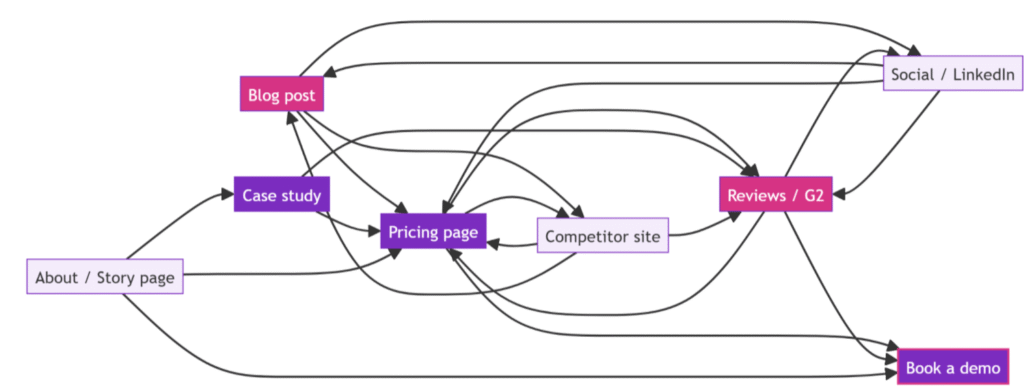
A typical buyer can hit twenty or more touchpoints before they even think about talking to sales. They move between channels with zero pattern. A blog today. A competitor tomorrow. A G2 review after midnight. A pricing page at lunch. Then silence for two weeks. Then back to the pricing page again.
There is no order.
No predictable flow.
No polite progression from “awareness” to “consideration” to “decision”.
Most buyers prefer to self-educate. They want clarity without commitment. They want proof without pressure. They want to compare you with every competitor before you even know they exist.
Their journey looks more like this:
blog → competitor → G2 → LinkedIn → pricing → reviews → ghosting → back to pricing.
This is the real b2b buying process. It’s messy, unpredictable and shaped by the buyer’s own timeline, not ours. The brands that respect this reality win. The ones that keep forcing buyers into a linear funnel lose, even if their diagrams look perfect.
Where the $20,000 Burned
This is the part no one likes to admit. The budget didn’t disappear because the market was slow or because “people don’t understand our product”. The money burned because every decision that shaped the strategy was built on assumptions instead of evidence.

We produced content the buyer never asked for. Articles that answered the wrong questions. Guides written for stages that didn’t exist. Assets created to support a funnel that buyers were never actually inside.
Then came the ads.
Targeting the wrong intent.
Pushing messages to people who were nowhere near the stage we thought they were in. Paying to drive traffic into a model the buyer wasn’t following in the first place.
There was no real journey mapping. No attempt to understand how people were moving between pages. No analysis of behaviour inside the product pages, comparison pages or pricing flows. We didn’t trace how buyers researched, paused, jumped, or returned.
And without behaviour analysis, there was no attribution.
We couldn’t see what influenced decisions.
We couldn’t see what created interest.
We couldn’t see what actually moved people forward.
We built assets because they looked good in a plan, not because buyers needed them. We produced deliverables instead of solving friction. We reacted to the funnel, not to the customer.
That’s how the twenty thousand disappeared.
Not in one moment, but decision by decision, all driven by a model that had nothing to do with how buyers actually buy.
5. The Core Diagnosis
The real issue was never the campaign. It wasn’t the SEO. It wasn’t the ads, the spend, or the channels. The problem was much simpler and far more damaging. We were trying to optimize a model that didn’t exist.
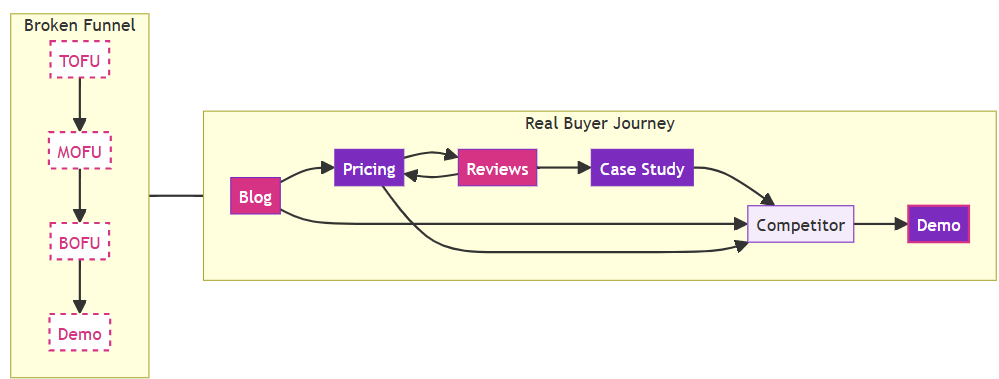
You can’t fix performance when the structure you’re optimising is imaginary. You can’t improve conversions when the buyer journey you’re measuring is based on stages the buyer never goes through. And you can’t analyse behaviour when the behaviour you expect has nothing to do with how people actually make decisions.
A broken campaign is not the problem.
A broken model is.
This is where most teams slip. They keep tweaking content, shifting budgets, adjusting keywords, rewriting landing pages and launching new ads. None of that matters if the system guiding those decisions is disconnected from reality.
You need a model that reflects the real b2b buyer journey mapping. A model that recognises multi touch behaviour, not linear progression. A model that aligns strategy with what buyers actually do, not what internal slides say they should do.
Once the model matches reality, everything else changes.
Content becomes relevant.
Keywords become intentional.
Attribution starts to make sense.
Analytics reveal the real flow.
Pipeline forecasting becomes accurate.
SEO strategy stops guessing and starts aligning.
The model is the foundation.
Get it wrong, and everything built on top of it collapses.
Get it right, and every channel becomes easier to win.
A New Framework: The Data-Driven Buyer Journey Model
If the old funnel is broken, you need a model that actually reflects how buyers move. Not how marketers want them to move. A real b2b journey model has to recognise multi touch behaviour, constant switching between channels and the way SaaS buyers self-educate long before they appear as a “lead”.
The model below isn’t theoretical. It’s built from observation. It matches what real buyers do in real SaaS buying processes. And it gives you a structure you can finally optimize.
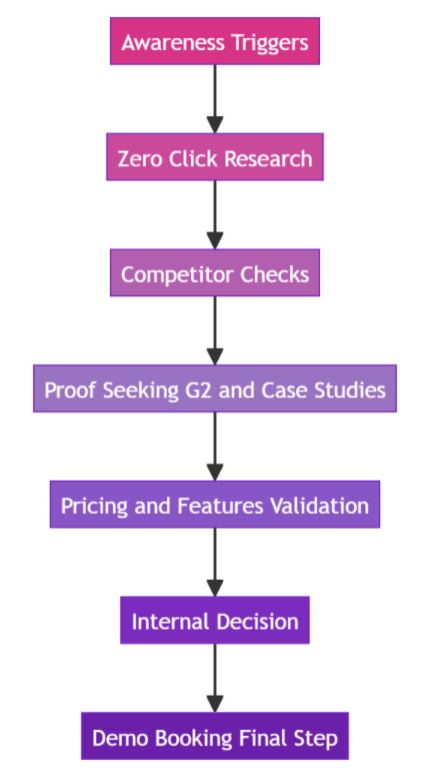
1. Awareness Triggers
Every journey starts with a problem, not with your brand. A pain point, a blocker, a missed target or a question that forces the buyer to look for clarity. This is the moment you need to understand, not control.
2. Zero-Click Research
Before hitting your site, buyers search, scan, collect definitions and compare ideas without committing to anything. They read summaries, check AI answers, skim competitor content and gather context with zero interaction from your side.
3. Competitor Checks
The next instinct is comparison. Buyers want to see what’s out there. They look at alternatives, pricing styles, positioning differences and who appears to “get” their problem faster. Competitors set the bar even before you speak.
4. Proof Seeking
Once the buyer sees potential, they look for evidence. G2 pages. Case studies. Testimonial depth. Screenshots. Real outcomes. They want proof that you’ve solved this problem for someone who looks like them.
5. Pricing and Features Validation
Only after they trust the solution do they check if the product actually fits. They dig into pricing pages, feature lists, limitations, add-ons and edge cases. This stage is critical because it determines whether you stay in the consideration set or get replaced by a competitor instantly.
6. Internal Decision
Most decisions are made internally long before anyone clicks “Book a Demo”. Teams discuss budget, priorities, timing and risk. You’re not in the room, and you don’t get a vote. Your content and clarity do the heavy lifting here.
7. Demo Booking
This is the final step. Not the first. When someone books a demo, they already trust the category, understand the problem, believe in the solution and see you as a serious option. The demo is confirmation, not discovery.
This is the real multi touch SaaS buying process.
And once you build your strategy around it, everything you create becomes sharper, faster and far more aligned with how buyers actually think.
How Not to Burn the Next $20,000
Once you understand how buyers actually move, the question becomes simple.
How do you make sure the next budget doesn’t disappear the same way?
The answer isn’t more content or bigger ads. It’s buyer journey optimisation built on real data, not assumptions.
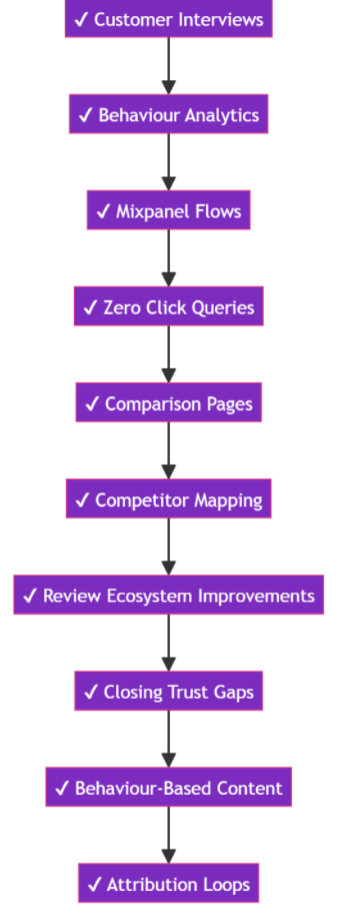
Below is the checklist every team should follow before spending another dollar.
1. Customer Interviews
Start with the source. Talk to real buyers. Ask how they researched, what they compared and what made them hesitate. Nothing replaces direct insight.
2. Behaviour Analytics
Track how people move across your website. Identify the pages they loop through, the dead ends, the exits and the moments where interest drops.
3. Mixpanel Flows
Use Mixpanel to map actual buyer paths. Look at the real sequence of actions, not the one you expected. This exposes the gaps instantly.
4. Zero-Click Queries
Analyse the questions buyers ask without clicking. This tells you what to write, what to clarify and which misconceptions you need to address.
5. Comparison Pages
Buyers compare before they consider. Build structured comparison pages that answer the questions they normally search on Google or G2.
6. Competitor Mapping
Track how competitors position themselves. Your buyer journey mapping is useless if you ignore the alternative paths buyers are evaluating.
7. Improve Your Review Ecosystem
Strengthen G2, Capterra and social proof. Buyers look for validation long before they look for features.
8. Close Trust Gaps
Identify where buyers pause. Missing case studies. Weak credibility signals. Unclear pricing. These micro-frictions lose more pipeline than bad ads.
9. Create Content Based on Behaviour
Write based on what buyers actually do, not what internal teams want to say. Let behaviour shape the editorial calendar.
10. Build Attribution Loops
Track influence across channels. Know what moved the buyer, what built trust and what pushed them closer to action. Attribution is the final layer of clarity.
This is how you protect the next twenty thousand.
Not with more noise.
But with a clearer understanding of the journey you’re actually trying to influence.
The $20,000 Truth
The real loss wasn’t the 20,000 dollars. It was the months spent polishing a funnel that never existed. We kept fixing pages, adjusting budgets and rewriting messages as if the problem was execution. It wasn’t. The problem was the foundation we were building on.
Once you stop assuming how buyers move and start observing how they actually decide, everything changes. The noise drops. The strategy sharpens. The results finally make sense.
The lesson is simple.
You don’t lose money because the market is broken.
You lose money when you build your strategy on a journey your buyers never take.
When you get the model right, the rest follows.


